Artificial Intelligence in Everyday Life
How AI Is Already Shaping the Way We Live, Work, and Decide
1/20/20263 min read
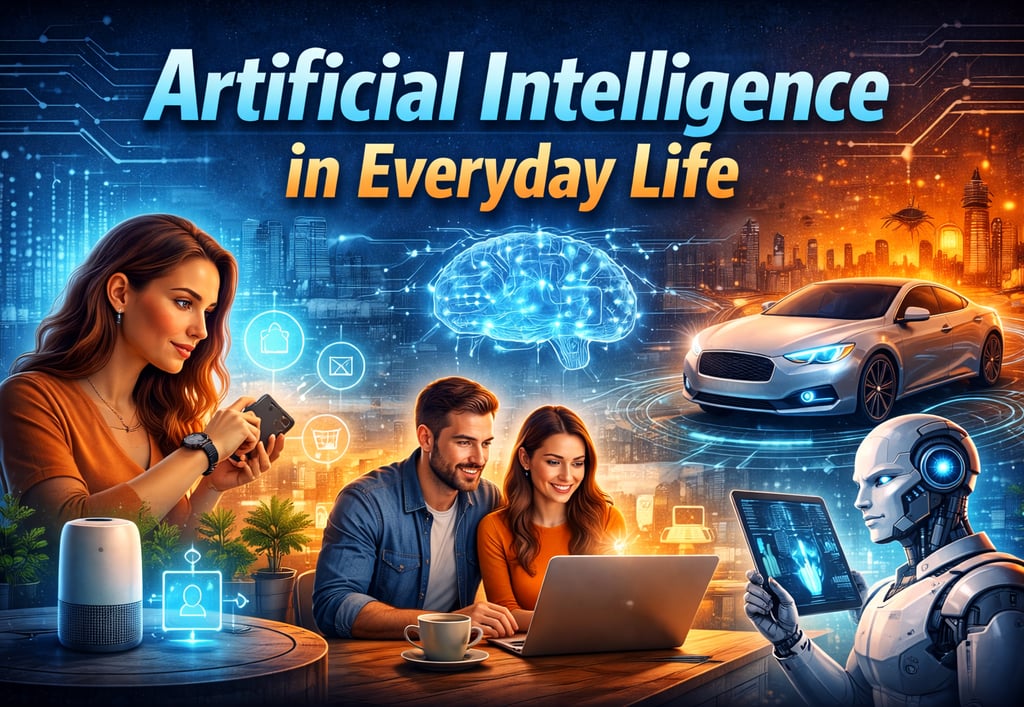

Artificial Intelligence is often discussed as a future technology, something that will impact society “one day.” In reality, AI is already deeply embedded in everyday life. Most people interact with Artificial Intelligence dozens of times a day — often without realizing it.
From unlocking smartphones with facial recognition to receiving personalized recommendations on streaming platforms, AI quietly influences decisions, habits, and routines. This invisible presence makes AI powerful, useful, and sometimes concerning.
In this in-depth guide, you will understand how Artificial Intelligence is used in everyday life, explained in practical, relatable terms. This article is designed for beginners who want clarity — not hype — and a realistic view of how AI affects daily experiences, opportunities, and responsibilities.
Why Artificial Intelligence Feels Invisible
One reason AI feels abstract is that it usually works behind the scenes.
AI is most effective when it:
Reduces friction
Saves time
Automates decisions
Improves convenience
When technology works smoothly, people stop noticing it.
Artificial Intelligence at Home
AI has become a silent assistant inside modern homes.
Smart Assistants and Voice Technology
Voice assistants respond to spoken commands, helping users:
Set reminders
Control smart devices
Search for information
Manage daily schedules
They rely on speech recognition and language processing to understand intent, not just words.
Smart Home Automation
AI-powered systems manage:
Lighting
Temperature
Security
Energy usage
Over time, these systems learn user preferences and adjust automatically, increasing comfort and efficiency.
Artificial Intelligence in Smartphones
Smartphones are among the most AI-powered devices people own.
AI enables:
Facial recognition
Camera enhancements
Predictive text
Battery optimization
These features adapt to user behavior, improving performance without manual input.
Artificial Intelligence in Transportation
AI plays a major role in how people move.
Navigation and Traffic Prediction
Navigation apps use AI to:
Predict traffic
Suggest faster routes
Adjust directions in real time
This saves time and reduces stress.
Ride-Sharing and Mobility
Ride-sharing platforms use AI to:
Match drivers and passengers
Optimize pricing
Predict demand
AI makes transportation more flexible and accessible.
Artificial Intelligence in Online Shopping
E-commerce relies heavily on AI.
AI systems:
Recommend products
Predict purchasing behavior
Optimize pricing
Detect fraud
These systems personalize shopping experiences, increasing convenience while influencing consumer decisions.
Artificial Intelligence in Entertainment and Media
Entertainment platforms use AI to keep users engaged.
Content Recommendations
Streaming services analyze:
Viewing history
Preferences
Interaction patterns
AI then suggests content tailored to individual tastes.
Music and Creative Content
AI helps generate:
Music playlists
Visual effects
Content edits
Human creativity leads — AI supports production.
Artificial Intelligence in Social Media
Social media platforms depend on AI algorithms.
AI determines:
What content users see
Which posts gain visibility
How ads are targeted
This shapes opinions, trends, and digital behavior.
Artificial Intelligence in Communication
AI improves communication efficiency.
Examples include:
Email filtering
Spam detection
Auto-replies
Language translation
These tools save time but require awareness to avoid miscommunication.
Artificial Intelligence in Education
Education is increasingly influenced by AI.
AI supports:
Personalized learning paths
Automated grading
Learning analytics
Accessibility tools
Teachers remain essential, but AI enhances support and scalability.
Artificial Intelligence in Healthcare
Healthcare benefits significantly from AI.
AI assists with:
Medical imaging analysis
Early disease detection
Patient monitoring
Administrative efficiency
AI supports professionals — it does not replace human care.
Artificial Intelligence in Finance
Financial systems rely on AI for:
Fraud detection
Risk assessment
Credit scoring
Personalized financial advice
AI improves speed and accuracy, but transparency remains crucial.
Artificial Intelligence at Work
AI reshapes daily work routines.
Employees use AI for:
Scheduling
Data analysis
Writing assistance
Project management
This increases productivity but requires new skills.
Artificial Intelligence and Decision-Making
AI influences decisions in subtle ways.
Examples include:
News recommendations
Product suggestions
Search results
Understanding this influence helps users maintain autonomy.
Benefits of AI in Everyday Life
AI offers many advantages:
Time savings
Convenience
Personalization
Efficiency
These benefits explain widespread adoption.
Hidden Risks of Everyday AI Use
Despite benefits, risks exist.
Loss of Privacy
AI systems collect data continuously.
Algorithmic Bias
AI may reflect societal bias.
Overreliance
Blind trust can reduce critical thinking.
Awareness is essential.
How to Use Artificial Intelligence More Consciously
Practical habits include:
Reviewing privacy settings
Questioning recommendations
Avoiding blind trust
Staying informed
Conscious use improves outcomes.
Artificial Intelligence and Digital Literacy
AI literacy is becoming a basic skill.
Understanding AI helps people:
Protect themselves
Make informed choices
Navigate digital spaces safely
Education is key.
AI Is Shaping Habits, Not Controlling Them
AI influences behavior, but humans still choose.
Technology reflects user behavior — not destiny.
Artificial Intelligence and Cultural Impact
AI affects:
Communication styles
Consumption habits
Creativity
Social norms
Cultural awareness matters as much as technical progress.
Will AI Become More Present in Daily Life?
Yes — but more subtle.
Future AI will:
Blend into environments
Anticipate needs
Reduce visible interaction
The challenge is maintaining awareness.
How Individuals Can Stay in Control
Staying in control means:
Learning how AI works
Setting boundaries
Valuing human judgment
Technology should serve people, not replace agency.
The Balance Between Convenience and Control
AI offers convenience, but convenience comes with trade-offs.
The goal is balance — not rejection or blind adoption.
Artificial Intelligence as a Daily Companion
AI is becoming:
A silent assistant
A productivity booster
A decision support system
Its value depends on responsible use.
Final Thoughts: Artificial Intelligence Is Already Part of Life
Artificial Intelligence is no longer arriving — it has arrived.
It shapes how people:
Communicate
Shop
Learn
Work
Relax
Understanding AI in everyday life empowers users to:
Make better choices
Protect privacy
Use technology intentionally
AI is not something happening to society.
It is something society is actively shaping every day.
The more people understand AI, the more control they retain over their digital lives
Contact
Contact us with any questions or suggestions
Phone
alexament2222@gmail.com
+55 19 99373-9646
© 2026. All rights reserved.
Links