How Artificial Intelligence Is Changing the Job Market
A Realistic, Beginner-Friendly and Future-Oriented Guide
1/20/20263 min read
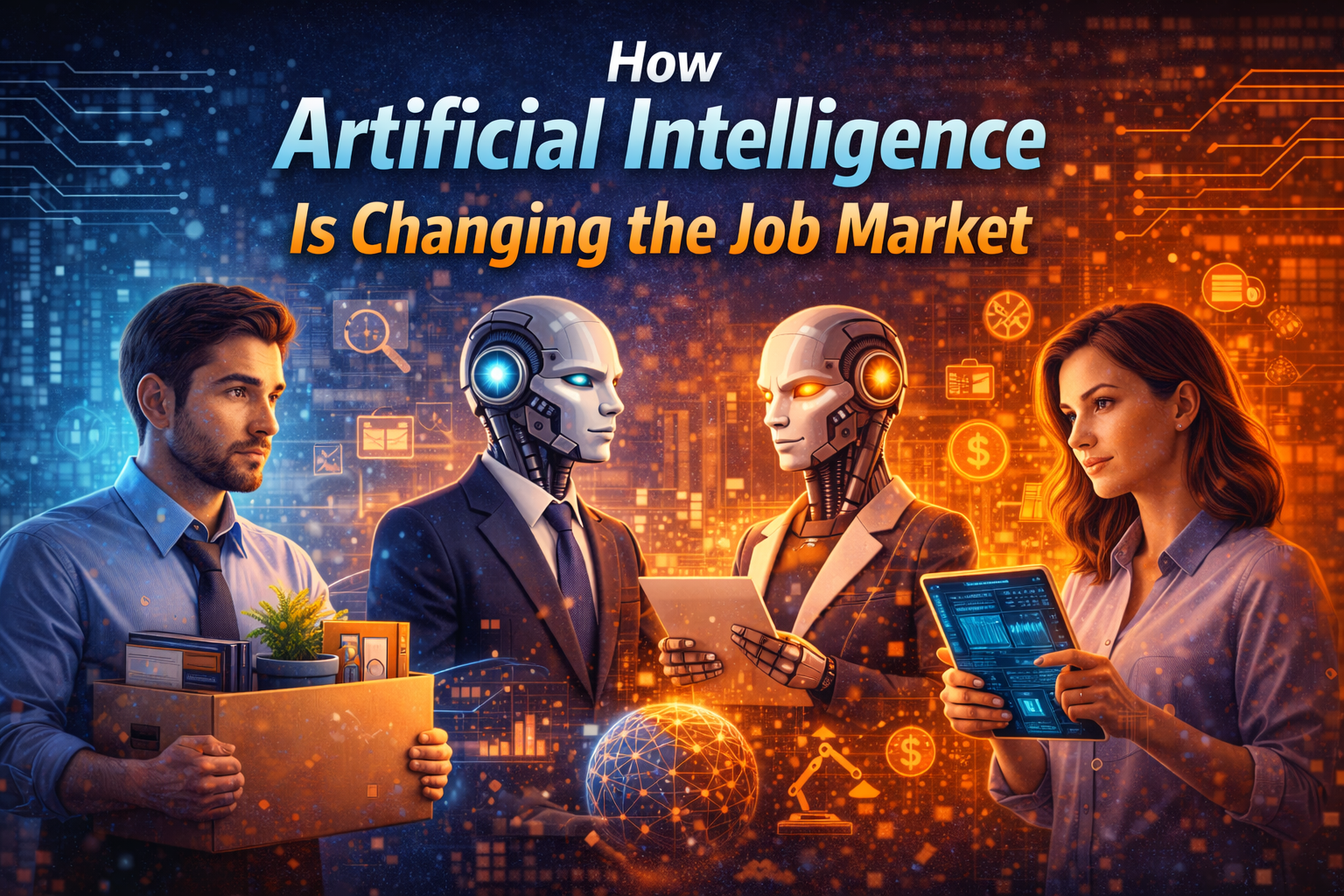
Artificial Intelligence is reshaping the job market faster than any technology before it. Unlike past innovations that affected specific industries, AI is influencing almost every profession, from office work and creative roles to healthcare, education, and logistics.
For many people, this transformation brings excitement. For others, it creates uncertainty and fear. Headlines often swing between two extremes: “AI will replace all jobs” or “AI will create endless opportunities.” Neither of these narratives tells the full story.
In this in-depth article, you will understand how Artificial Intelligence is changing the job market in practical, real-world terms. This guide is designed for beginners and professionals alike, focusing on clarity, balance, and realistic expectations — without hype or panic.
Why AI Is Having Such a Strong Impact on Jobs
Artificial Intelligence stands out because it can:
Analyze large amounts of data
Learn from patterns
Automate cognitive tasks, not just manual labor
Improve itself over time
Unlike traditional automation, AI affects both blue-collar and white-collar jobs, which explains the scale of its impact.
A Brief Look at Past Technological Shifts
History shows that technology always changes work:
The Industrial Revolution replaced manual labor but created factories
Computers reduced clerical jobs but created digital careers
The internet eliminated some roles but enabled remote work
AI follows the same pattern — job transformation, not total job extinction.
Jobs Most Affected by Artificial Intelligence
Some roles are more exposed to automation than others, especially those that involve:
Repetitive tasks
Predictable workflows
Rule-based decision-making
Examples include:
Data entry
Basic customer support
Simple bookkeeping
Routine administrative work
This does not mean these jobs disappear overnight, but they evolve or shrink over time.
Jobs That Are Being Transformed, Not Replaced
Many professions are not disappearing — they are changing.
Office and Administrative Roles
AI handles scheduling, document processing, and reporting, allowing employees to focus on higher-value tasks.
Marketing and Content Creation
AI assists with research, drafts, and analytics, while humans guide strategy and creativity.
Healthcare
AI supports diagnostics and data analysis, but human judgment remains irreplaceable.
Transformation is the dominant trend.
New Jobs Created by Artificial Intelligence
AI is also generating entirely new roles, such as:
AI trainers and prompt specialists
Data analysts
AI ethics consultants
Automation managers
Machine learning engineers
These jobs did not exist a decade ago and continue to grow.
How AI Is Changing Skill Requirements
The most valuable skills today are shifting.
Skills Losing Importance
Manual data processing
Repetitive reporting
Pure memorization
Skills Gaining Importance
Critical thinking
Creativity
Emotional intelligence
Problem-solving
Digital literacy
AI rewards adaptability.
The Rise of Hybrid Jobs
Many modern roles combine human and AI capabilities.
Examples:
Marketers who use AI analytics
Designers who work with generative tools
HR professionals using AI screening tools
These hybrid jobs increase productivity rather than replace workers.
Artificial Intelligence and Remote Work
AI accelerates remote work by:
Automating communication
Improving collaboration tools
Supporting asynchronous workflows
This expands global job opportunities and increases competition.
AI and Entry-Level Jobs: A Real Concern
Entry-level roles often involve repetitive tasks — the same tasks AI handles well.
This creates challenges for:
Young professionals
Career switchers
New graduates
The solution lies in education, mentorship, and reskilling, not resistance.
The Importance of Reskilling and Upskilling
Lifelong learning is no longer optional.
Workers who thrive in the AI era:
Learn continuously
Adapt to new tools
Build transferable skills
Online courses, microlearning, and AI-assisted education are key resources.
How Businesses Are Adapting to AI in the Workplace
Companies adopt AI to:
Reduce costs
Improve efficiency
Scale operations
However, successful companies also:
Train employees
Redesign workflows
Maintain human oversight
AI adoption without strategy often fails.
Artificial Intelligence and Job Quality
AI can improve job quality by:
Reducing repetitive tasks
Lowering stress
Increasing focus on meaningful work
But it can also:
Increase monitoring
Reduce autonomy
Create pressure to perform
Balance matters.
Ethical Challenges in the AI-Driven Job Market
Key ethical concerns include:
Algorithmic bias
Transparency in hiring
Worker surveillance
Data privacy
Ethical AI is essential for trust.
How Governments Are Responding to AI and Employment
Governments worldwide are:
Updating labor laws
Funding reskilling programs
Discussing AI regulation
Policy plays a critical role in managing transition.
Artificial Intelligence and Income Inequality
AI can:
Increase productivity
Create wealth
But without inclusive policies, it may:
Concentrate power
Widen income gaps
Social responsibility is required.
How Individuals Can Prepare for the AI Job Market
Practical steps include:
Learning how AI works
Using AI tools daily
Developing human-centric skills
Staying informed about trends
Preparation reduces fear.
AI Is Not Replacing Humans — It’s Changing How We Work
The most realistic view is simple:
AI replaces tasks, not people
Humans who adapt stay relevant
Collaboration beats competition
Work evolves — it always has.
The Role of Human Skills in an AI World
Skills AI struggles to replicate:
Empathy
Ethical judgment
Cultural understanding
Leadership
These skills will remain valuable.
AI and Career Flexibility
AI increases career mobility by:
Enabling freelancing
Supporting entrepreneurship
Lowering barriers to entry
People can build careers without traditional paths.
Common Myths About AI and Jobs
“AI Will Eliminate All Jobs”
False. It reshapes jobs.
“Only Tech Experts Will Survive”
False. Soft skills matter more than ever.
“AI Makes Humans Obsolete”
False. Humans guide AI.
How to Use AI as a Career Advantage
Use AI to:
Learn faster
Improve productivity
Expand capabilities
Explore new fields
AI is a tool, not a rival.
The Future Job Market: What to Expect
In the coming years:
AI adoption will grow
Hybrid roles will increase
Continuous learning will be standard
Adaptability will define success.
Final Thoughts: Opportunity Through Adaptation
Artificial Intelligence is changing the job market — but change does not equal disaster.
For those who:
Stay curious
Learn continuously
Embrace collaboration with AI
The future holds more opportunity than risk.
AI is not the end of work.
It is the beginning of a new way of working.
Contact
Contact us with any questions or suggestions
Phone
alexament2222@gmail.com
+55 19 99373-9646
© 2026. All rights reserved.
Links