How Artificial Intelligence Works in Practice (Without Technical Jargon)
Descrição do post.
1/20/20264 min read
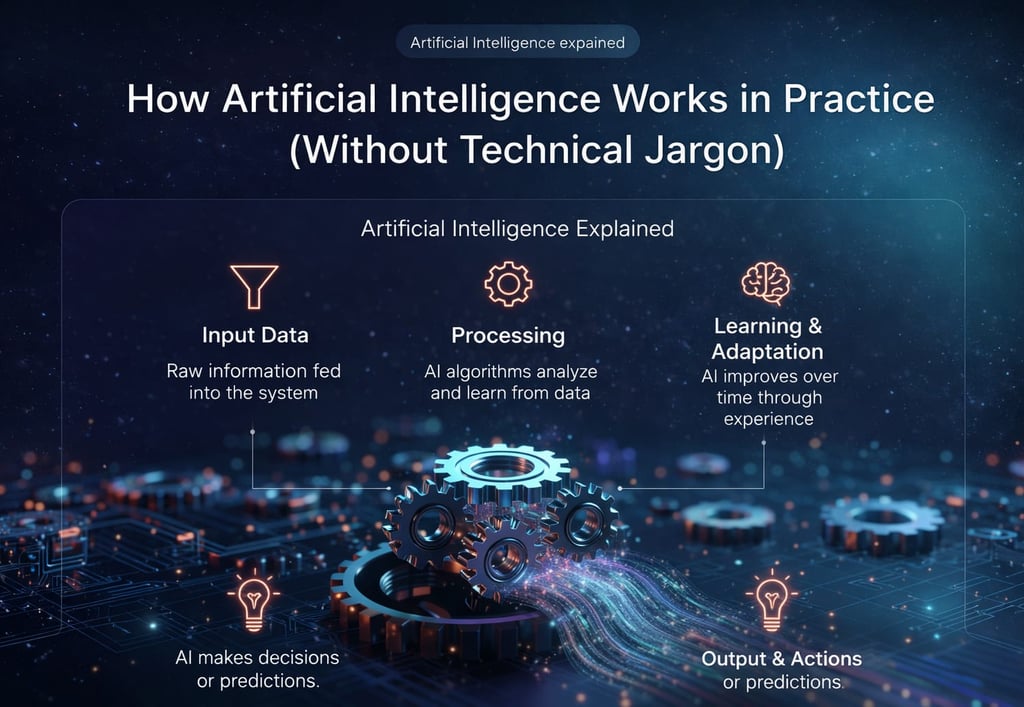

Artificial Intelligence may sound intimidating at first. Many people associate it with complex formulas, advanced programming, or futuristic machines that only experts can understand. But in reality, Artificial Intelligence works in much simpler ways than most people imagine — especially when we focus on how it is used in everyday life.
You don’t need to be a programmer, engineer, or tech enthusiast to understand how AI works in practice. If you know how to use a smartphone, browse the internet, or interact with digital services, you already have real-world experience with Artificial Intelligence.
In this article, you will learn how Artificial Intelligence actually works, step by step, using plain English, practical examples, and zero technical jargon. The goal is to help you understand what happens behind the scenes — without overwhelming you.
Why Understanding How AI Works Matters
Before diving into the details, it’s important to understand why this knowledge is useful.
When you understand how AI works in practice, you can:
Use AI tools more effectively
Make better decisions online
Avoid misinformation and exaggerated claims
Adapt more easily to technological changes
Feel more confident about the future of work and technology
AI is not magic. It is a system created by humans, with clear strengths and limitations.
Artificial Intelligence Is Not a “Thinking Machine”
One of the most common misunderstandings about AI is the idea that it “thinks” like a human.
In reality:
AI does not have consciousness
AI does not understand meaning the way humans do
AI does not have emotions or intentions
What AI does extremely well is analyzing data and identifying patterns — much faster than humans.
This distinction is crucial to understanding how AI works in practice.
The Core Idea Behind Artificial Intelligence
At its core, Artificial Intelligence follows a simple logic:
AI learns from examples, identifies patterns, and uses those patterns to make predictions or decisions.
Everything AI does — from recommending a video to detecting fraud — follows this basic principle.
Step-by-Step: How Artificial Intelligence Works
Even though AI systems can be complex internally, the overall process can be broken down into clear steps.
Step 1: Collecting Data
Data is the foundation of Artificial Intelligence.
AI systems need large amounts of data to learn. This data can come from many sources, such as:
Text (articles, messages, emails)
Images (photos, videos)
Audio (voice recordings, music)
Numbers (financial data, statistics)
User behavior (clicks, searches, preferences)
For example:
A navigation app collects traffic data
A streaming platform collects viewing habits
A shopping website collects browsing and purchase behavior
Without data, AI cannot function.
Step 2: Cleaning and Organizing Data
Raw data is often messy and inconsistent. Before AI can learn from it, the data must be:
Organized
Filtered
Standardized
This step ensures that the AI system is learning from relevant and reliable information.
Although users don’t see this process, it plays a major role in AI accuracy.
Step 3: Learning From Patterns
This is where Artificial Intelligence truly begins to work.
The AI system analyzes the data and looks for patterns, such as:
Repeated behaviors
Similar characteristics
Trends over time
For example:
If users who watch one video often watch another similar video, AI notices the connection
If fraudulent transactions share similar patterns, AI learns to recognize them
AI does not “understand” the data — it detects mathematical relationships within it.
Step 4: Making Predictions or Decisions
Once patterns are identified, AI uses them to:
Predict outcomes
Recommend content
Flag unusual behavior
Automate responses
This is why AI can:
Suggest movies you might like
Autocomplete your messages
Recommend products
Identify spam or fraud
These decisions are based on probabilities, not certainty.
Step 5: Learning Over Time
One of the most powerful aspects of AI is its ability to improve continuously.
As AI receives more data and feedback, it:
Refines predictions
Reduces errors
Adapts to new patterns
This is why AI systems often become more accurate the longer they are used.
Artificial Intelligence in Everyday Life: Practical Examples
To truly understand how AI works, let’s look at familiar situations.
AI in Smartphones
Modern smartphones rely heavily on AI.
Examples include:
Face recognition
Voice assistants
Camera enhancements
Predictive text
When your phone suggests the next word while typing, AI is analyzing patterns from millions of similar texts.
AI in Social Media
Social media platforms use AI to decide:
Which posts appear in your feed
Which ads you see
Which videos are recommended
The system analyzes your interactions — likes, comments, time spent — and predicts what will keep you engaged.
AI in Streaming Platforms
Streaming services like Netflix and YouTube use AI to:
Analyze what you watch
Compare your behavior with similar users
Suggest new content
This is why recommendations often feel surprisingly accurate.
AI in Online Shopping
E-commerce platforms use AI to:
Recommend products
Optimize pricing
Detect fraudulent purchases
If you’ve ever seen “Customers also bought this,” you’ve interacted with AI.
AI in Banking and Finance
Banks use AI to:
Detect suspicious transactions
Analyze spending habits
Improve customer service through chatbots
These systems operate in real time, protecting users without human intervention.
AI in Navigation and Transportation
Navigation apps use AI to:
Analyze traffic conditions
Predict travel time
Suggest faster routes
The system learns from millions of drivers simultaneously.
Machine Learning: The Engine Behind AI
Most modern AI systems rely on Machine Learning.
Instead of being programmed with fixed rules, machine learning systems:
Learn from examples
Improve through repetition
Adapt to new data
This approach allows AI to handle complex, real-world scenarios.
Why AI Needs Large Amounts of Data
AI performance depends heavily on data quality and quantity.
More data allows AI to:
Detect subtle patterns
Reduce bias
Improve accuracy
This is why large platforms often have more advanced AI systems — they have access to more data.
Common Misconceptions About How AI Works
“AI Understands Like Humans”
No. AI recognizes patterns, not meaning.
“AI Is Always Accurate”
No. AI can make mistakes, especially with poor data.
“AI Works Without Human Input”
No. Humans design, train, and monitor AI systems.
Limitations of Artificial Intelligence in Practice
Despite its capabilities, AI has limitations:
It depends on data quality
It struggles with context and nuance
It cannot reason beyond its training
Understanding these limits helps avoid unrealistic expectations.
Is Artificial Intelligence Watching You?
AI systems analyze data, but they do not “watch” in a human sense.
Most AI works by:
Processing anonymous data
Identifying patterns at scale
Following privacy regulations (when properly implemented)
Transparency and regulation are key concerns worldwide.
How Businesses Use AI in Practice
Companies use AI to:
Improve customer experience
Reduce costs
Increase efficiency
Automate repetitive tasks
AI is a tool for optimization, not replacement of human intelligence.
How Individuals Can Use AI Today
You don’t need a company or a tech background to use AI.
Today, individuals use AI for:
Writing and content creation
Studying and learning
Organizing tasks
Improving productivity
Many AI tools are designed specifically for beginners.
The Role of Humans in AI Systems
Humans remain essential in AI development:
Designing systems
Defining goals
Monitoring outcomes
Ensuring ethical use
AI works best when combined with human judgment.
The Future of AI in Daily Life
In the coming years, AI will become:
More personalized
More accessible
More integrated into everyday tools
The focus will increasingly shift toward human-centered AI.
Final Thoughts: AI Is Practical, Not Magical
Artificial Intelligence may sound complex, but in practice, it follows simple principles:
Data
Patterns
Learning
Improvement
Understanding how AI works helps you use technology with confidence instead of fear.
AI is not here to replace humans. It is here to support, enhance, and simplify tasks when used responsibly.
Contact
Contact us with any questions or suggestions
Phone
alexament2222@gmail.com
+55 19 99373-9646
© 2026. All rights reserved.
Links