Is Artificial Intelligence Dangerous?
Understanding the Real Risks and the Real Benefits
1/22/20264 min read
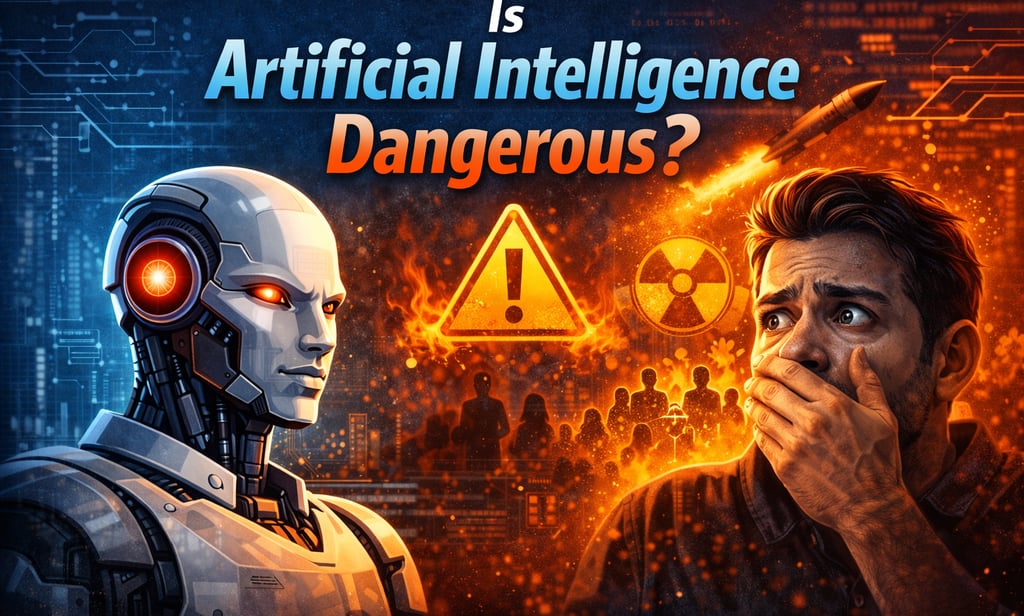
Artificial Intelligence often appears in headlines surrounded by extreme opinions. Some describe it as a revolutionary force that will improve every aspect of life. Others warn that AI is dangerous, uncontrollable, and a threat to humanity.
The truth, as usual, lies somewhere in between.
Artificial Intelligence is neither a miracle nor a monster. It is a powerful technology created by humans, shaped by human decisions, data, and intentions. Like any tool, AI can bring enormous benefits — and real risks — depending on how it is designed and used.
In this article, we will explore whether Artificial Intelligence is truly dangerous, what the real risks are, which fears are exaggerated, and how the benefits of AI already outweigh many concerns when used responsibly.
Why Artificial Intelligence Is Often Seen as Dangerous
Fear around AI usually comes from three main sources:
Lack of understanding
Media exaggeration
Fictional portrayals
Movies, series, and viral headlines often depict AI as autonomous, emotional, and hostile. In reality, modern AI systems do not have intentions, desires, or awareness.
What people fear is not AI itself — but loss of control, misuse, and lack of regulation.
What Artificial Intelligence Actually Is (and Is Not)
AI systems are designed to:
Analyze data
Identify patterns
Generate responses
Support decision-making
AI does not:
Have consciousness
Feel emotions
Make independent moral choices
Act without human input
Understanding this distinction is essential to evaluate real risks.
The Real Benefits of Artificial Intelligence
Before focusing on dangers, it is important to recognize why AI is being adopted so widely.
Increased Efficiency and Productivity
AI automates repetitive tasks, allowing people to focus on:
Strategy
Creativity
Human interaction
This improves productivity across industries.
Better Decision Support
AI analyzes large volumes of data faster than humans, helping professionals make more informed decisions in:
Healthcare
Finance
Logistics
Research
AI supports judgment — it does not replace it.
Advances in Healthcare
AI improves:
Medical imaging
Early disease detection
Patient monitoring
Drug discovery
These applications save time, resources, and lives.
Accessibility and Inclusion
AI-powered tools help:
Translate languages
Assist people with disabilities
Provide personalized education
Technology becomes more inclusive when designed responsibly.
The Real Risks of Artificial Intelligence
While AI brings benefits, real risks do exist and should not be ignored.
Risk #1: Bias and Discrimination
AI systems learn from data. If data reflects social bias, AI can reproduce or amplify it.
Examples include:
Biased hiring systems
Unequal credit assessments
Facial recognition inaccuracies
The risk lies not in AI itself, but in biased data and poor oversight.
Risk #2: Loss of Privacy
AI systems rely heavily on data.
Without proper safeguards, this can lead to:
Excessive data collection
Surveillance concerns
Misuse of personal information
Privacy protection is a major challenge in AI development.
Risk #3: Overreliance on AI Systems
Blind trust in AI can reduce critical thinking.
Risks include:
Accepting incorrect outputs
Ignoring context
Reducing human accountability
AI should assist decisions, not replace responsibility.
Risk #4: Job Displacement Anxiety
AI changes how work is done.
Some tasks are automated, creating fear of job loss. However:
Most jobs evolve rather than disappear
New roles emerge
Human skills remain essential
The real risk is lack of adaptation, not AI itself.
Risk #5: Misinformation and Deepfakes
AI can generate:
Fake images
Synthetic voices
Misleading text
This raises concerns about trust, manipulation, and misinformation.
Detection tools and regulation are essential to mitigate this risk.
Is Artificial Intelligence Dangerous by Itself?
Short answer: No.
AI is not dangerous on its own. It does not act independently or with intent.
The danger comes from:
Poor design
Lack of regulation
Misuse by humans
Absence of ethical standards
Technology reflects human values — for better or worse.
The Role of Humans in AI Safety
AI systems require human involvement at every stage:
Design
Training
Deployment
Monitoring
Human oversight is not optional — it is essential.
Regulation and Ethical Frameworks
Governments and organizations worldwide are developing:
AI regulations
Transparency requirements
Ethical guidelines
These frameworks slow reckless use and encourage responsible innovation.
AI in the Wrong Hands vs AI Used Responsibly
Like many technologies, AI can be harmful when misused.
However, responsible use enables:
Medical breakthroughs
Safer transportation
Better public services
Improved efficiency
The difference lies in governance, not capability.
Common Myths About Dangerous AI
Myth #1: AI Will Become Self-Aware
Modern AI has no consciousness.
Myth #2: AI Will Take Over Humanity
AI lacks autonomy and intent.
Myth #3: AI Cannot Be Controlled
AI systems can be limited, monitored, and regulated.
Balancing Innovation and Caution
Stopping AI development is unrealistic — and undesirable.
The goal is balance:
Encourage innovation
Protect society
Maintain transparency
Ensure accountability
Fear alone does not lead to better outcomes.
How Individuals Can Use AI Safely
Everyday users can reduce risks by:
Understanding limitations
Verifying information
Protecting personal data
Avoiding blind trust
Digital literacy is part of AI safety.
AI as a Tool, Not a Threat
When viewed correctly, AI is:
A productivity tool
A decision support system
A creativity enhancer
It is not a replacement for human judgment.
The Future of AI Safety
AI safety will increasingly focus on:
Explainability
Fairness
Transparency
Human-centered design
Responsible development is becoming a priority, not an afterthought.
Why Fear Alone Is Not a Strategy
Fear may attract attention, but it does not solve problems.
Understanding AI:
Reduces panic
Encourages responsible use
Supports better regulation
Knowledge leads to control.
Final Thoughts: Is Artificial Intelligence Dangerous?
Artificial Intelligence is powerful — and power requires responsibility.
AI is not inherently dangerous.
It is as safe or as risky as the humans who design and use it.
When guided by ethics, transparency, and oversight, AI delivers:
Innovation
Efficiency
Inclusion
Progress
The real challenge is not stopping AI — it is using it wisely.
Understanding both risks and benefits empowers society to shape AI in a way that serves people, not the other way around.
Contact
Contact us with any questions or suggestions
Phone
alexament2222@gmail.com
+55 19 99373-9646
© 2026. All rights reserved.
Links