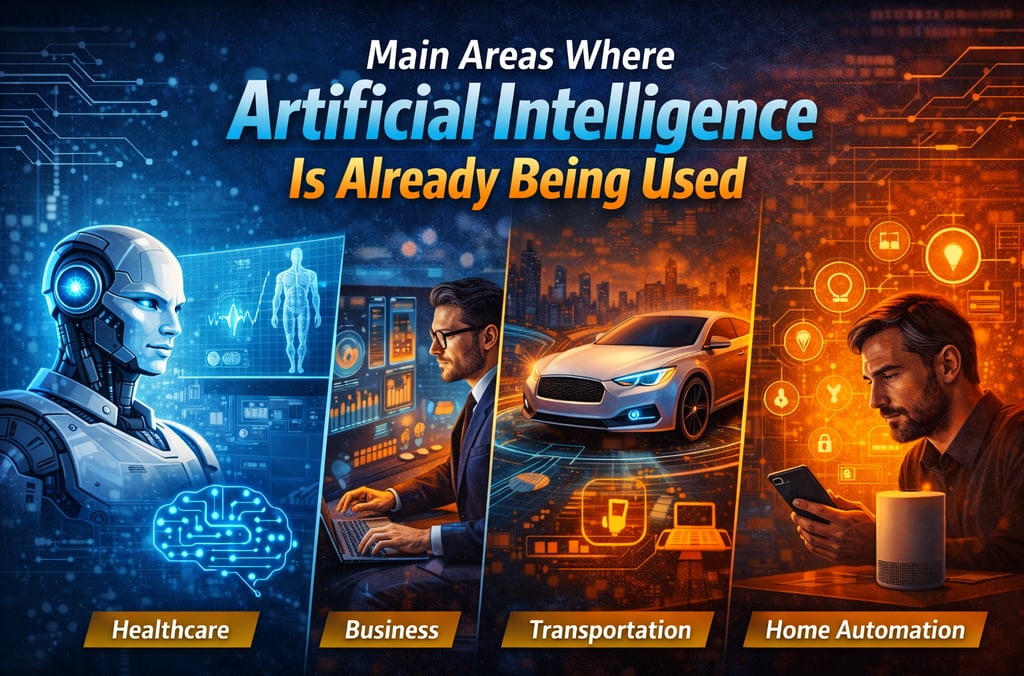
Main Areas Where Artificial Intelligence Is Already Being Used
How AI Is Transforming Industries, Services, and Everyday Experiences
1/22/20263 min read
Artificial Intelligence is often described as a technology of the future. However, this idea is misleading. AI is not something that will impact society — it is already doing so, across multiple industries and aspects of daily life.
Many people use AI every day without realizing it. From personalized recommendations to fraud detection and medical imaging, Artificial Intelligence has quietly become a core part of modern systems.
In this article, you will discover the main areas where Artificial Intelligence is already being used, with practical explanations, real-world examples, and a clear understanding of how AI creates value today — not in theory, but in practice.
This guide is designed for beginners and non-technical readers who want clarity instead of buzzwords.
Why Artificial Intelligence Is Being Adopted So Quickly
AI adoption is accelerating because it solves real problems.
Organizations use AI to:
Process large volumes of data
Reduce operational costs
Improve accuracy
Support decision-making
Increase efficiency
As data becomes more abundant, AI becomes more valuable.
Artificial Intelligence in Healthcare
Healthcare is one of the most impactful areas for AI adoption.
Medical Imaging and Diagnostics
AI systems analyze:
X-rays
MRIs
CT scans
They help detect patterns that may be difficult for the human eye to spot, supporting doctors in early diagnosis and treatment planning.
AI does not replace medical professionals — it enhances their capabilities.
Patient Monitoring and Predictive Care
AI-powered tools monitor patient data in real time, identifying early signs of complications and helping healthcare teams act proactively.
This leads to:
Faster responses
Better outcomes
Reduced hospital workloads
Artificial Intelligence in Finance and Banking
Financial institutions rely heavily on AI.
Fraud Detection and Security
AI analyzes transaction patterns to identify unusual behavior and potential fraud. These systems operate continuously, providing faster and more accurate protection.
Credit Analysis and Risk Assessment
Banks use AI to:
Evaluate creditworthiness
Assess financial risk
Improve loan decisions
Giving faster responses while reducing bias and error.
Artificial Intelligence in E-Commerce and Retail
AI plays a central role in online shopping experiences.
Personalized Recommendations
E-commerce platforms analyze:
Browsing behavior
Purchase history
Preferences
AI then suggests products tailored to individual users, increasing satisfaction and conversion rates.
Inventory and Pricing Optimization
Retailers use AI to:
Predict demand
Manage inventory
Adjust pricing dynamically
This reduces waste and improves profitability.
Artificial Intelligence in Marketing and Advertising
Marketing is one of the fastest-growing AI use cases.
Audience Targeting and Personalization
AI helps marketers:
Segment audiences
Personalize messaging
Optimize ad delivery
This leads to more relevant campaigns and higher engagement.
Content and Performance Analysis
AI tools analyze performance data to identify what works and what doesn’t, allowing continuous optimization.
Artificial Intelligence in Customer Service
Customer service has changed dramatically with AI.
Chatbots and Virtual Assistants
AI-powered chatbots handle:
Common questions
Order tracking
Basic support requests
They provide instant responses while human agents focus on complex issues.
Sentiment and Feedback Analysis
AI analyzes customer feedback to understand satisfaction levels and identify recurring problems.
Artificial Intelligence in Education
Education is undergoing a digital transformation with AI.
Personalized Learning
AI-powered platforms adapt content to:
Individual learning pace
Skill level
Learning style
This improves engagement and retention.
Academic Support and Assessment
AI assists with:
Automated grading
Progress tracking
Learning analytics
Teachers gain insights while maintaining control.
Artificial Intelligence in Transportation and Mobility
Transportation systems increasingly rely on AI.
Navigation and Traffic Prediction
AI analyzes traffic data to:
Suggest optimal routes
Predict congestion
Reduce travel time
This improves efficiency for both individuals and cities.
Autonomous and Assisted Driving
AI supports driver-assistance systems that improve safety through:
Lane detection
Collision avoidance
Adaptive cruise control
Full autonomy is still evolving, but progress is continuous.
Artificial Intelligence in Manufacturing
Manufacturing benefits significantly from AI.
Predictive Maintenance
AI predicts equipment failures before they happen, reducing downtime and repair costs.
Quality Control
AI-powered vision systems inspect products with high precision, identifying defects quickly and consistently.
Artificial Intelligence in Human Resources
HR departments increasingly use AI tools.
Recruitment and Talent Matching
AI helps:
Screen resumes
Match candidates to roles
Reduce time-to-hire
Human judgment remains essential, but AI improves efficiency.
Employee Analytics
AI analyzes engagement and performance data to support better workforce decisions.
Artificial Intelligence in Cybersecurity
Cyber threats evolve rapidly, making AI essential.
AI systems:
Detect anomalies
Identify potential attacks
Respond faster than traditional systems
This improves digital resilience.
Artificial Intelligence in Media and Entertainment
Entertainment platforms rely heavily on AI.
Content Recommendations
Streaming services use AI to suggest movies, series, and music based on user preferences.
Creative Production Support
AI assists creators with:
Video editing
Audio processing
Visual effects
Creativity remains human-led, with AI as a support tool.
Artificial Intelligence in Agriculture
Agriculture is becoming more data-driven.
AI helps farmers:
Monitor crop health
Predict yields
Optimize resource usage
This improves sustainability and efficiency.
Artificial Intelligence in Logistics and Supply Chains
AI improves logistics by:
Optimizing routes
Predicting delays
Managing inventory
Global supply chains become more resilient.
Artificial Intelligence in Government and Public Services
Governments use AI to:
Improve service delivery
Detect fraud
Analyze public data
Responsible use and transparency are essential.
Why AI Adoption Continues to Grow
AI adoption grows because it delivers measurable benefits:
Cost reduction
Speed
Accuracy
Scalability
As tools become more accessible, adoption spreads across industries.
Common Concerns About AI Usage
Despite benefits, concerns remain:
Privacy
Bias
Transparency
Overreliance
Responsible implementation addresses these challenges.
The Human Role in AI Systems
AI does not operate independently.
Humans:
Design systems
Define objectives
Interpret results
Make final decisions
AI supports — it does not replace human responsibility.
Artificial Intelligence Is Already Part of the Present
AI is no longer experimental.
It is:
Embedded in systems
Used at scale
Delivering real value
Understanding where AI is already used helps reduce fear and confusion.
Final Thoughts: AI Is Everywhere — Quietly
Artificial Intelligence is not a distant innovation.
It already shapes:
Healthcare
Finance
Education
Commerce
Transportation
Communication
The more people understand where and how AI is used, the better they can engage with technology consciously and responsibly.
AI is not about replacing humans — it is about augmenting human potential across industries.
Contact
Contact us with any questions or suggestions
Phone
alexament2222@gmail.com
+55 19 99373-9646
© 2026. All rights reserved.
Links