The Advantages and Disadvantages of Artificial Intelligence
A Balanced, Beginner-Friendly and Real-World Guide
1/20/20264 min read
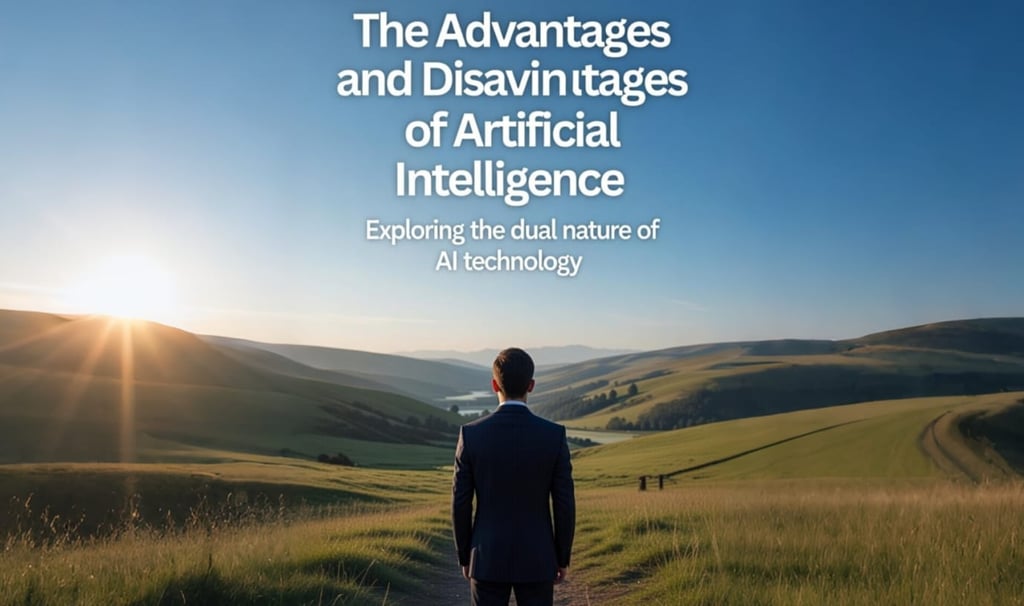
Artificial Intelligence is one of the most talked-about technologies of our time. Some people see it as a powerful ally that makes life easier, while others fear it as a threat to jobs, privacy, and even human creativity. The truth lies somewhere in between.
Artificial Intelligence is neither a miracle nor a monster. It is a tool — and like any tool, its impact depends on how it is designed, used, and regulated.
In this comprehensive guide, you will explore the main advantages and disadvantages of Artificial Intelligence, explained in clear, practical language. This article is designed especially for beginners who want to understand AI without hype, fear, or technical jargon.
By the end, you will have a realistic view of how AI affects daily life, work, businesses, and society as a whole.
What Artificial Intelligence Really Is (Quick Recap)
Artificial Intelligence refers to systems that can perform tasks that normally require human intelligence. These tasks include:
Understanding language
Recognizing images
Making predictions
Analyzing large amounts of data
Automating decisions
AI does not have emotions, intentions, or awareness. It operates by recognizing patterns and generating outputs based on data and algorithms.
Understanding this helps separate real benefits from exaggerated fears.
Why It’s Important to Talk About Pros and Cons
Technology is never neutral. Every innovation brings:
Opportunities
Risks
Trade-offs
Discussing both advantages and disadvantages helps:
Users make informed decisions
Businesses adopt AI responsibly
Governments create better policies
Society avoid blind adoption
Balanced understanding is essential in the AI era.
The Main Advantages of Artificial Intelligence
Let’s start with the positive side — the reasons why AI adoption continues to grow worldwide.
1. Increased Productivity and Efficiency
One of the strongest advantages of AI is its ability to handle repetitive tasks quickly and accurately.
AI can:
Process large volumes of data in seconds
Automate routine operations
Reduce human error
Work continuously without fatigue
This allows people to focus on more creative, strategic, or human-centered activities.
Real-World Example
Customer support chatbots handle common questions, freeing human agents to solve complex issues.
2. Better Decision-Making Through Data Analysis
AI systems can analyze massive datasets that would be impossible for humans to process manually.
They help:
Identify trends
Detect anomalies
Predict outcomes
Support strategic decisions
In areas like finance, healthcare, and logistics, AI improves accuracy and speed.
3. Accessibility and Inclusion
AI has the potential to make the world more accessible.
Examples include:
Speech-to-text for people with hearing impairments
Text-to-speech for visually impaired users
Language translation tools
Assistive technologies for learning disabilities
These applications promote digital inclusion.
4. Personalization at Scale
AI enables personalized experiences in:
Education
Entertainment
Marketing
E-commerce
Instead of one-size-fits-all solutions, AI adapts content and services to individual preferences.
5. Medical and Healthcare Advancements
AI is transforming healthcare by:
Assisting in medical imaging analysis
Supporting early disease detection
Optimizing hospital workflows
Accelerating drug discovery
AI does not replace doctors, but it helps them make better, faster decisions.
6. Cost Reduction for Businesses
Automation powered by AI can significantly reduce operational costs.
Businesses benefit from:
Fewer manual errors
Faster processes
Reduced labor costs for repetitive tasks
This is especially impactful for small businesses with limited resources.
7. Continuous Learning and Improvement
AI systems improve over time as they process more data.
This means:
Better predictions
More accurate outputs
Increased reliability
Unlike static software, AI adapts.
The Disadvantages of Artificial Intelligence
Despite its benefits, AI also raises serious concerns that should not be ignored.
1. Job Displacement and Workforce Disruption
One of the biggest fears around AI is job loss.
AI can automate:
Data entry
Customer support
Manufacturing tasks
Basic analysis roles
While new jobs are created, transitions can be painful for workers without access to reskilling opportunities.
2. Dependence on Technology
Overreliance on AI can:
Reduce critical thinking skills
Create skill gaps
Increase vulnerability to system failures
Human oversight remains essential.
3. Bias and Discrimination
AI systems learn from data — and data can reflect human bias.
This can lead to:
Unfair hiring decisions
Discriminatory lending practices
Biased facial recognition systems
Bias in AI is a social problem reflected through technology.
4. Privacy and Data Security Risks
AI often relies on large amounts of personal data.
Risks include:
Data misuse
Surveillance concerns
Unauthorized data access
Strong privacy regulations are necessary.
5. Lack of Transparency (The “Black Box” Problem)
Many AI systems make decisions that are difficult to explain.
This creates challenges in:
Legal accountability
Trust
Ethical evaluation
Transparency is critical, especially in sensitive areas.
6. High Development and Maintenance Costs
While AI can reduce costs long-term, building advanced systems requires:
Skilled professionals
Infrastructure
Continuous updates
This can widen the gap between large corporations and smaller players.
7. Ethical and Moral Concerns
AI raises questions such as:
Who is responsible for AI decisions?
How much autonomy should AI have?
Can AI be trusted in life-critical systems?
Ethics must guide AI development.
AI in Everyday Life: Pros and Cons in Practice
AI already influences daily activities:
Recommendation systems
Navigation apps
Voice assistants
Spam filters
Most people use AI without realizing it — enjoying benefits while accepting trade-offs.
Artificial Intelligence in Education
Advantages
Personalized learning
Automated feedback
Learning analytics
Disadvantages
Reduced human interaction
Data privacy concerns
Over-standardization
Balanced integration is key.
Artificial Intelligence in Business
Advantages
Automation
Market insights
Scalability
Disadvantages
Implementation costs
Workforce resistance
Ethical risks
Successful adoption requires strategy.
Artificial Intelligence and Creativity
AI can:
Generate images
Write text
Compose music
However, it lacks:
Emotional context
Lived experience
Cultural intuition
AI assists creativity — it does not replace it.
How to Use Artificial Intelligence Responsibly
Responsible AI use includes:
Human oversight
Transparency
Ethical guidelines
Continuous evaluation
Users and developers share responsibility.
Is Artificial Intelligence Good or Bad?
Artificial Intelligence is neither inherently good nor bad.
It is:
Powerful
Neutral by design
Shaped by human decisions
The real question is how we choose to use it.
The Future of Artificial Intelligence: Balanced Expectations
AI will continue to evolve, but:
Humans will remain essential
Regulation will increase
Ethical standards will matter more
Understanding both advantages and disadvantages prepares society for smarter adoption.
How Beginners Should Think About AI
Instead of fear or blind enthusiasm:
Learn the basics
Use AI as a tool
Stay informed
Keep human judgment central
AI literacy is becoming a fundamental skill.
Final Thoughts: Technology With Responsibility
Artificial Intelligence offers remarkable benefits, but it also presents serious challenges.
By understanding both sides, users can:
Make better choices
Avoid unrealistic expectations
Use AI safely and effectively
The future of AI is not about replacing humans — it is about augmenting human potential with responsibility.
Contact
Contact us with any questions or suggestions
Phone
alexament2222@gmail.com
+55 19 99373-9646
© 2026. All rights reserved.
Links