The Difference Between Artificial Intelligence, Machine Learning, and Automation
What Each One Really Means — and Why Confusing Them Can Be a Mistake
1/22/20264 min read
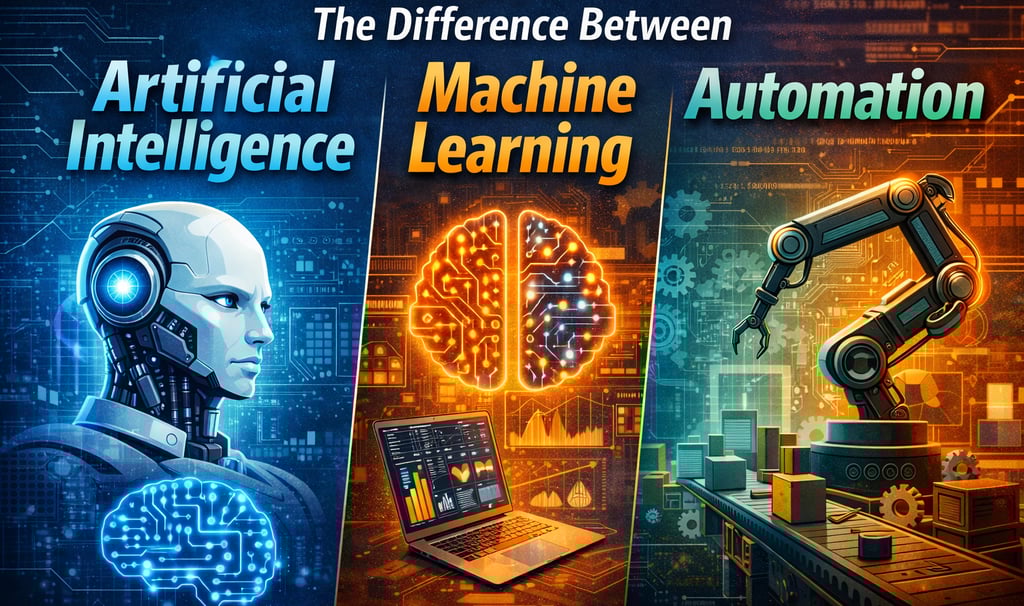
Artificial Intelligence, Machine Learning, and Automation are three of the most frequently used terms in today’s technology landscape. They appear in job descriptions, business strategies, news headlines, and marketing campaigns. Yet, despite being widely mentioned, they are often misunderstood — and frequently used as if they meant the same thing.
In reality, Artificial Intelligence, Machine Learning, and Automation are related, but they are not interchangeable. Each one serves a different purpose, operates in a different way, and has a distinct impact on businesses, careers, and everyday life.
This article explains, in clear and practical language, the real difference between Artificial Intelligence, Machine Learning, and Automation, using real-world examples instead of technical jargon. By the end, you will understand how these technologies work, how they interact, and why knowing the difference matters more than ever.
Why These Terms Are So Often Confused
The confusion exists for three main reasons:
They are frequently used together
Marketing language oversimplifies them
They all aim to improve efficiency
Because they often appear in the same context, many people assume they describe the same technology. But that assumption leads to poor decisions — especially in business and career planning.
Understanding the differences allows you to:
Choose the right tools
Set realistic expectations
Avoid exaggerated promises
Communicate clearly with teams and clients
What Is Automation?
Automation is the oldest and simplest of the three concepts.
Definition of Automation
Automation refers to using technology to perform repetitive tasks based on predefined rules. It does not learn, adapt, or make independent decisions. It simply follows instructions.
If X happens, do Y.
That is automation.
Examples of Automation in Everyday Life
Automation is everywhere, often without being noticed:
Automatic email responses
Scheduled social media posts
Assembly lines in factories
Spreadsheet formulas
Workflow tools that move tasks between stages
In all these cases, the system behaves exactly as programmed.
Key Characteristics of Automation
Rule-based
Predictable
No learning involved
Requires human setup and maintenance
Automation is powerful for efficiency but limited in flexibility.
What Automation Is NOT
Automation:
Does not understand context
Does not improve on its own
Does not analyze complex data
Does not make judgments
If something unexpected happens, automation usually fails or stops.
What Is Artificial Intelligence?
Artificial Intelligence (AI) is a broader concept.
Definition of Artificial Intelligence
Artificial Intelligence refers to systems designed to perform tasks that normally require human intelligence.
These tasks include:
Understanding language
Recognizing images
Making predictions
Identifying patterns
Supporting decisions
AI focuses on simulating intelligence, not just following instructions.
AI Does Not Mean Consciousness
A common myth is that AI “thinks” like humans.
In reality:
AI does not have awareness
AI does not have emotions
AI does not have intentions
It processes data using algorithms designed by humans.
Examples of Artificial Intelligence in Practice
Voice assistants understanding speech
Recommendation systems on streaming platforms
Fraud detection systems
Image recognition in medical scans
Chatbots that respond conversationally
These systems handle complexity that automation alone cannot.
Machine Learning: The Bridge Between Automation and AI
Machine Learning (ML) sits inside Artificial Intelligence.
Definition of Machine Learning
Machine Learning is a subset of AI that allows systems to learn from data instead of relying only on predefined rules.
Rather than being told exactly what to do, the system identifies patterns and improves performance over time.
How Machine Learning Works (Simplified)
Data is collected
The system analyzes patterns
A model is trained
Predictions are made
Results improve with more data
No constant reprogramming is required.
Everyday Examples of Machine Learning
Email spam filters
Product recommendations
Voice recognition accuracy improvements
Personalized ads
Predictive text suggestions
Each interaction helps the system learn.
Key Differences Between Automation, AI, and Machine Learning
Decision-Making Ability
Automation: No decisions
AI: Simulates decision-making
Machine Learning: Improves decisions over time
Adaptability
Automation: Fixed behavior
AI: Limited adaptability
Machine Learning: High adaptability
Learning Capability
Automation: None
AI (without ML): Limited
Machine Learning: Core function
Complexity Handling
Automation: Low
AI: Medium to high
Machine Learning: High
A Simple Analogy to Understand the Difference
Imagine a traffic system:
Automation is a traffic light that changes at fixed intervals
Artificial Intelligence is a traffic system that reacts to traffic volume
Machine Learning is a system that improves traffic flow by learning from past congestion
Each level adds intelligence and adaptability.
Can Automation Exist Without AI?
Yes.
Many automated systems do not use AI at all. They rely entirely on rules and triggers.
Examples:
Payroll systems
Backup scheduling
Basic customer workflows
Automation works best in stable, predictable environments.
Can AI Exist Without Machine Learning?
Yes, but with limitations.
Some AI systems rely on:
Expert rules
Decision trees
Logic-based programming
However, modern AI increasingly depends on Machine Learning because it scales better.
Why Machine Learning Is Driving Modern AI Growth
Machine Learning allows AI systems to:
Improve accuracy
Handle massive datasets
Adapt to new situations
Reduce manual configuration
This is why ML is central to modern AI tools.
How Businesses Use These Technologies Together
In real-world applications, businesses often combine all three.
Example:
Automation handles workflows
AI analyzes data
Machine Learning improves predictions
This combination maximizes efficiency and intelligence.
Common Marketing Misuse of These Terms
Many products labeled as “AI-powered” are actually:
Simple automation
Rule-based systems
This misuse creates unrealistic expectations.
Understanding the difference protects consumers and businesses from misleading claims.
Choosing the Right Technology for the Right Problem
Not every problem requires AI.
Use:
Automation for repetitive tasks
AI for complex decision support
Machine Learning for pattern-based predictions
Overengineering increases cost and complexity.
Impact on Jobs and Skills
Each technology affects work differently.
Automation replaces repetitive tasks
AI supports decision-making
Machine Learning increases productivity
Human roles shift toward:
Strategy
Creativity
Oversight
Ethical judgment
Ethical and Practical Considerations
More intelligence brings more responsibility.
Key concerns include:
Bias in data
Transparency
Accountability
Privacy
Understanding the technology helps manage risks.
Why This Distinction Matters for Careers
Professionals who understand these differences:
Communicate better
Choose relevant skills
Avoid hype-driven decisions
Stay competitive
Clarity equals advantage.
The Future: Convergence, Not Replacement
These technologies are not competing — they are converging.
Future systems will:
Automate workflows
Learn from data
Support human decisions
The goal is augmentation, not replacement.
Final Thoughts: Clarity Over Buzzwords
Artificial Intelligence, Machine Learning, and Automation are powerful — but different.
Automation follows rules.
Machine Learning learns from data.
Artificial Intelligence brings it all together.
Understanding these distinctions helps individuals and organizations:
Make smarter decisions
Invest wisely
Adapt confidently
Technology moves fast, but clarity keeps people in control.
Contact
Contact us with any questions or suggestions
Phone
alexament2222@gmail.com
+55 19 99373-9646
© 2026. All rights reserved.
Links