The Evolution of Artificial Intelligence: From Early Concepts to 2026
Explore the evolution of artificial intelligence from early concepts to 2026. Learn how AI has transformed industries, creativity, and the future of work.
2/27/20264 min read
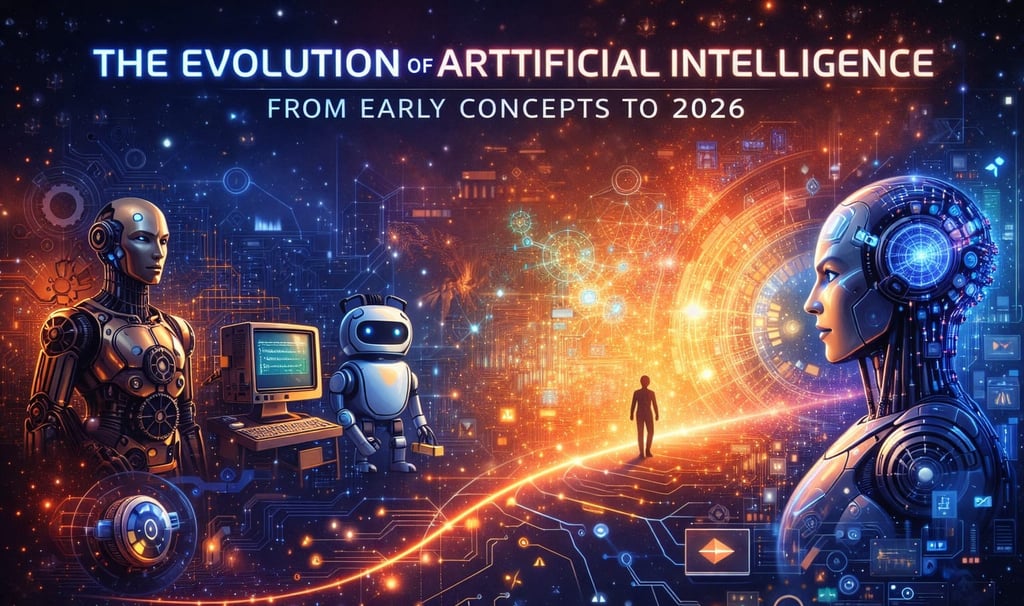
Artificial Intelligence (AI) has moved from science fiction to a central part of modern life. What once existed only in the imaginations of authors and researchers has now become a tangible force shaping industries, creativity, and daily experiences. From early theoretical concepts to powerful AI systems used today, the journey of AI is both fascinating and transformative.
Understanding how AI evolved not only helps us appreciate its current capabilities but also provides insight into what the future may hold. In this article, we will explore the history, breakthroughs, challenges, and future potential of AI in 2026.
Early Concepts and Foundations of AI
The roots of artificial intelligence trace back to the mid-20th century. The foundational ideas included:
Mathematical Logic and Computation: In the 1940s and 1950s, pioneers like Alan Turing explored whether machines could think. The famous Turing Test questioned if a machine could mimic human intelligence convincingly.
Symbolic AI and Early Algorithms: During the 1950s and 1960s, AI research focused on symbolic reasoning, trying to teach machines rules and logic to solve problems. Programs like the Logic Theorist and early chess-playing algorithms were groundbreaking at the time.
These early efforts were limited by computational power and the lack of large datasets, but they laid the conceptual groundwork for future AI developments.
The AI Winter: Challenges and Setbacks
Despite the optimism in the 1960s and 1970s, AI research faced several challenges:
Overpromising: Early AI researchers made ambitious claims about what machines could achieve, leading to high expectations.
Limited Hardware: Computers were slow, memory was scarce, and algorithms were constrained by technology.
Funding Cuts: Frustration over slow progress led to reduced funding, causing the first “AI Winter” in the mid-1970s.
A second AI Winter occurred in the late 1980s to early 1990s due to similar challenges, as symbolic AI failed to scale and meet expectations. These periods were critical learning moments, showing the gap between AI theory and practical implementation.
The Rise of Machine Learning
The late 1990s and early 2000s marked a turning point with the rise of machine learning. Unlike symbolic AI, machine learning allows computers to learn from data rather than relying strictly on pre-programmed rules.
Key Developments:
Neural Networks and Deep Learning: Early neural networks gained momentum, inspired by the human brain’s structure. By the 2010s, deep learning techniques enabled more complex pattern recognition in images, audio, and text.
Big Data Explosion: The internet created vast datasets that machines could learn from, fueling AI progress.
Computational Power: GPUs and cloud computing provided the necessary horsepower to train large AI models efficiently.
This era saw AI moving from laboratories into real-world applications — from voice assistants like Siri and Alexa to recommendation engines on Netflix and YouTube.
AI Goes Mainstream
By the late 2010s and early 2020s, AI entered everyday life:
Natural Language Processing (NLP) allowed machines to understand and generate human language, leading to chatbots, translation apps, and virtual assistants.
Computer Vision enabled self-driving cars, facial recognition, and automated surveillance.
Generative AI began to create original images, music, and text, exemplified by platforms like DALL·E, ChatGPT, and Seedance 2.0 (link to Seedance article).
The convergence of AI, machine learning, and cloud infrastructure allowed startups and enterprises to innovate at unprecedented speed, democratizing AI tools beyond elite research labs.
The Impact of AI Across Industries
AI’s evolution has not only changed technology but also transformed industries:
Healthcare: AI-assisted diagnostics, predictive analytics, and personalized treatment plans.
Finance: Fraud detection, algorithmic trading, and automated customer support.
Retail: AI-driven recommendations, inventory forecasting, and cashier-less stores.
Content Creation: Automation tools like Seedance 2.0 allow artists and marketers to generate high-quality visuals quickly.
Cybersecurity: AI monitors networks, detects anomalies, and predicts potential breaches (link to cybersecurity article).
Even traditional industries are now integrating AI to optimize operations, reduce costs, and improve decision-making.
Challenges and Ethical Considerations
Despite rapid advancements, AI brings challenges:
Bias in AI Models: Models trained on skewed datasets can perpetuate discrimination.
Job Displacement: Automation continues to replace repetitive tasks, impacting some professions.
Privacy Concerns: AI systems often require massive amounts of data, raising questions about personal privacy and consent.
Regulation and Accountability: Who is responsible when AI systems make mistakes? Legal frameworks are still evolving.
Understanding these challenges is critical for responsibly integrating AI into society and business.
The Future of AI in 2026 and Beyond
Looking forward, AI will continue to evolve:
Hyperautomation: AI will increasingly handle complex workflows, integrating multiple systems seamlessly.
Human-AI Collaboration: AI won’t replace humans entirely; it will assist, augment, and enhance human capabilities.
Smarter Creativity: Generative AI will revolutionize design, music, and storytelling while offering tools for creators to expand their imagination.
Predictive Decision-Making: AI will help organizations anticipate trends, customer needs, and potential risks more accurately.
The key takeaway: AI’s evolution is less about replacing humans and more about redefining the roles we play in a tech-driven world.
How to Stay Ahead
For website owners, content creators, and professionals, the evolution of AI presents opportunities:
Upskill Continuously – Learn AI tools relevant to your field, like automation, content generation, or data analysis.
Leverage AI Strategically – Use AI to augment your work, not replace it entirely (link to AI in jobs article).
Prioritize Cybersecurity – As AI adoption grows, so does exposure to potential attacks (link to cybersecurity article).
Stay Informed – Following trends in AI evolution allows you to anticipate and adapt to change faster than competitors.
Conclusion
The journey of AI, from early theoretical ideas to the sophisticated systems we use today, highlights both human ingenuity and the power of technology. In 2026, AI is more integrated into our lives than ever before, transforming how we work, create, and interact.
Understanding the evolution of AI is not just an academic exercise — it is essential for navigating the modern digital landscape, protecting your work, and leveraging the opportunities that this technology provides.
AI is no longer a distant possibility; it’s a present reality that continues to evolve. Those who understand its history, current applications, and future potential will be best positioned to thrive in a world increasingly shaped by intelligent machines.
Contact
Contact us with any questions or suggestions
Phone
alexament2222@gmail.com
+55 19 99373-9646
© 2026. All rights reserved.
Links