The Seedance 2.0 Buzz: Creative Revolution or Just Another Tech Hype?
Seedance 2.0 is going viral — but is it changing digital creativity or just riding the AI wave? Here’s what you need to know.
3/1/20263 min read
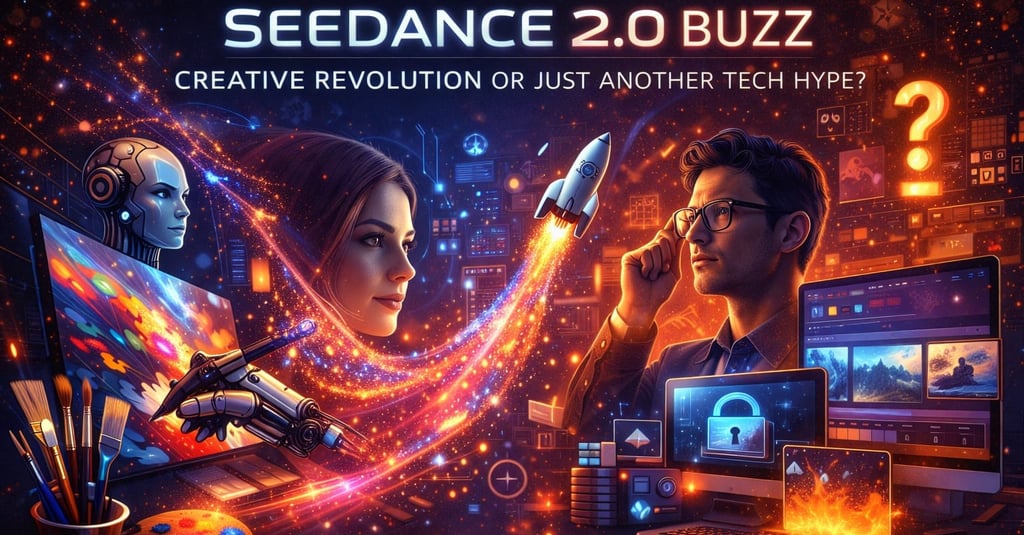
The internet has a predictable pattern: new tools appear, go viral almost overnight, and disappear just as quickly. But every once in a while, a technology breaks out of the “hype cycle” and genuinely changes the way we create, work, and communicate.
Seedance 2.0 emerged right in the middle of this dynamic.
Over the past few months, the platform has gained serious traction across social media, tech forums, and digital creator communities. Videos showcasing AI-generated animations and automated visual effects have sparked curiosity — and debate.
So the real question is: are we witnessing a true creative revolution powered by artificial intelligence, or is Seedance 2.0 just another short-lived trend riding the AI wave?
What Is Seedance 2.0?
Seedance 2.0 is an AI-powered creative tool designed to simplify visual content production. Instead of relying on complex editing software and hours of manual work, users can generate animations and visual effects using simple prompts or commands.
The core idea is straightforward: democratize digital creation.
In practical terms, that means enabling people with little to no technical background to produce professional-looking visual content. This aligns with a broader movement in the tech industry — using artificial intelligence to lower barriers and streamline creative processes.
Just as AI tools are transforming writing, coding, and image generation, Seedance 2.0 positions itself as part of this new wave of creative automation.
Why Did It Spread So Quickly?
Several factors contributed to its rapid growth.
1. Perfect Timing in the AI Boom
We’re living in a moment when anything labeled “AI-powered” instantly captures attention. Businesses are investing heavily in artificial intelligence, creators are experimenting with it, and audiences are eager to see what’s possible.
Seedance 2.0 entered the market at exactly the right time.
2. Visually Impressive Results
Much of its virality came from short demo videos. When a tool can generate high-quality visual effects in seconds — especially effects that traditionally require advanced skills — people naturally want to share it.
There’s a strong psychological impact in seeing something that “should take hours” done almost instantly.
3. Low Barrier to Entry
Unlike professional-grade design software that requires training and experience, Seedance emphasizes simplicity. That dramatically expands its potential audience.
Accessibility is often the key ingredient behind viral tech tools.
4. Influencer Amplification
Digital creators and tech influencers quickly picked up the tool and began showcasing their results. That social proof accelerated adoption and fueled the conversation even further.
The Debate: Is AI Replacing Creative Professionals?
Every time automation enters a creative field, the same concern emerges: will AI replace human professionals?
With Seedance 2.0, designers and visual artists have voiced understandable concerns. If anyone can generate polished visual effects with minimal effort, where does that leave trained professionals?
However, history suggests that new tools rarely eliminate entire professions — they reshape them.
Photography didn’t eliminate painting. Digital software didn’t eliminate graphic design; it transformed it.
More often than not, professionals who adapt and integrate new tools into their workflow gain a competitive advantage. Instead of replacing creativity, AI can enhance productivity and expand what’s possible.
Ethical Questions and Copyright Concerns
Like many AI-driven platforms, Seedance 2.0 raises important questions about data usage and originality.
If an AI system is trained on large datasets of existing creative works, to what extent is the generated output truly original? And who owns the rights to that output?
These aren’t issues unique to Seedance. They’re part of a broader global conversation about generative AI, intellectual property, and regulation.
As AI tools continue evolving, legal frameworks will need to evolve alongside them.
The Real Impact on the Digital Market
Even if part of the excitement surrounding Seedance 2.0 is driven by hype, it reflects a larger and undeniable shift: creative automation is here to stay.
The digital landscape has already gone through multiple waves of disruption:
The rise of social media
The expansion of digital marketing
The automation of advertising campaigns
AI-driven customer service and analytics
Seedance 2.0 fits naturally into this progression.
It’s not just about creating animations faster. It’s about reducing technical friction and making creative production more accessible to a broader audience.
Revolution or Overhyped Trend?
It’s easy to dismiss viral tools as temporary fads. And in many cases, that skepticism is justified.
However, even if Seedance 2.0 itself evolves, rebrands, or gets replaced by something more advanced, the underlying shift it represents is much bigger than one platform.
Creative AI tools are becoming a permanent part of the digital ecosystem.
The real transformation isn’t about a single product — it’s about the normalization of AI as a creative partner.
Final Thoughts
Seedance 2.0 doesn’t signal the end of human creativity, nor does it guarantee the replacement of skilled professionals.
What it does represent is a clear turning point in how digital content is produced.
In today’s rapidly evolving tech landscape, the advantage won’t belong to those who resist change, but to those who learn how to adapt and strategically leverage new tools.
Creative automation isn’t the future anymore — it’s the present.
Contact
Contact us with any questions or suggestions
Phone
alexament2222@gmail.com
+55 19 99373-9646
© 2026. All rights reserved.
Links