What Is Artificial Intelligence? A Simple and Complete Beginner’s Guide
Descrição do post.
1/20/20265 min read
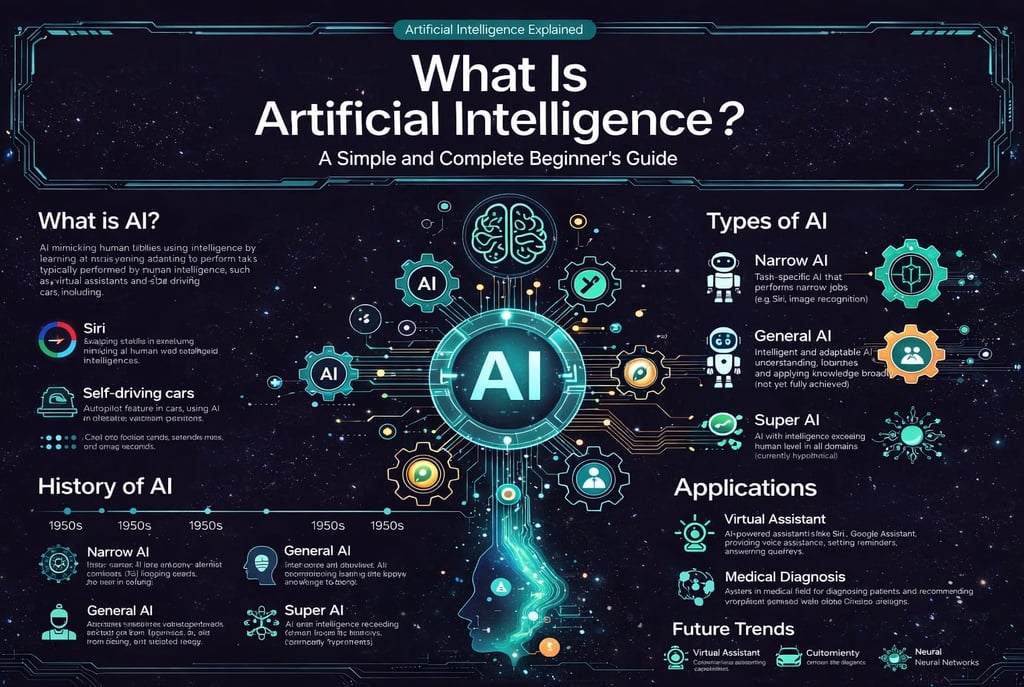
Artificial Intelligence, commonly known as AI, is no longer a futuristic concept reserved for science fiction movies, advanced laboratories, or tech giants. Today, AI is deeply embedded in our everyday lives, often working quietly in the background while making our digital experiences faster, more personalized, and more efficient.
From smartphones and social media to online shopping, banking, navigation apps, and streaming platforms, Artificial Intelligence is everywhere. Even if you have never studied technology, chances are you already interact with AI multiple times a day.
But what exactly is Artificial Intelligence?
How does it work in simple terms?
Is AI dangerous?
Will it replace human jobs?
And why is everyone talking about it right now?
This complete beginner’s guide to Artificial Intelligence was created to answer all these questions in a clear, practical, and accessible way. No technical background, programming knowledge, or advanced vocabulary is required. If you are curious about AI and want to truly understand it, this guide is for you.
What Is Artificial Intelligence?
Artificial Intelligence is a field of computer science focused on creating machines and software capable of performing tasks that normally require human intelligence.
In practical terms, AI refers to systems that can:
Learn from information and past experiences
Analyze large amounts of data
Recognize patterns and similarities
Make decisions or predictions
Understand language, images, sounds, and behaviors
Unlike traditional computer programs that simply follow predefined rules, AI systems can adapt, improve, and evolve over time.
This ability to learn and improve is what makes Artificial Intelligence fundamentally different from older types of software.
Artificial Intelligence Explained in Simple Terms
If we had to explain AI in the most straightforward way possible, it would be this:
Artificial Intelligence is when machines are designed to imitate certain aspects of human thinking in order to solve problems or perform tasks automatically.
AI does not have emotions, consciousness, or personal opinions. It does not “think” like a human brain. Instead, it uses data, mathematics, and statistical models to simulate intelligent behavior.
In other words, AI is about patterns, probabilities, and learning from data.
Why Artificial Intelligence Became So Popular
Artificial Intelligence is not new, but it has grown rapidly in recent years for three main reasons:
1. Massive Amounts of Data
Every day, people generate enormous amounts of data through smartphones, social media, online searches, videos, photos, and digital services. AI thrives on data.
2. Powerful Computers
Modern computers and cloud servers are far more powerful than those available decades ago, making complex calculations possible in seconds.
3. Advanced Algorithms
New AI techniques, especially in machine learning and deep learning, allow systems to learn more efficiently and accurately.
Together, these factors created the perfect environment for AI to evolve and become widely accessible.
A Brief History of Artificial Intelligence
The idea of intelligent machines has existed for centuries, but Artificial Intelligence as a scientific field officially began in the 1950s.
In 1950, mathematician and computer scientist Alan Turing asked a groundbreaking question:
“Can machines think?”
This question led to the development of early AI theories and experiments. However, progress was slow due to limited computing power and data.
Over the decades, AI experienced periods of excitement followed by disappointment, known as “AI winters.” It was only in the 21st century, with the rise of the internet and big data, that AI truly began to flourish.
Today, we are living in what many experts describe as the Artificial Intelligence revolution.
How Does Artificial Intelligence Work?
Although AI may sound complex, its basic logic can be understood through a simple process.
Step 1: Data Input
AI systems are fed with data. This data can include text, images, videos, audio recordings, numbers, or user interactions.
Step 2: Pattern Recognition
The system analyzes the data to identify patterns, similarities, and relationships.
Step 3: Learning and Optimization
Based on feedback and results, the AI improves its performance over time.
The key idea is that AI learns from examples, not from explicit instructions for every situation.
Real-Life Examples of Artificial Intelligence
Many people use AI daily without realizing it. Here are some familiar examples:
Smartphones
Face recognition for unlocking devices
Predictive text and autocorrect
Voice assistants like Siri or Google Assistant
Social Media
AI decides which posts, videos, and ads appear in your feed based on your behavior and interests.
Online Shopping
E-commerce platforms recommend products using AI-powered recommendation systems.
Streaming Platforms
Netflix, YouTube, and Spotify suggest content based on what you watch or listen to.
Banking and Finance
AI helps detect fraudulent transactions and unusual account activity.
Navigation Apps
Google Maps and similar apps use AI to analyze traffic and suggest faster routes.
Types of Artificial Intelligence
Artificial Intelligence can be classified based on its capabilities.
Narrow AI (Weak AI)
This is the most common type of AI today. Narrow AI is designed to perform one specific task extremely well.
Examples include:
Chatbots
Image recognition systems
Recommendation engines
These systems cannot perform tasks outside their defined scope.
General AI (Strong AI)
General AI would be capable of performing any intellectual task that a human can do. This type of AI does not yet exist and remains a theoretical concept.
Superintelligent AI
Superintelligent AI refers to a hypothetical system that surpasses human intelligence in all areas. This idea is widely discussed in science fiction and ethical debates but is not a current reality.
Artificial Intelligence vs. Machine Learning vs. Deep Learning
These terms are often used interchangeably, but they are not the same.
Artificial Intelligence
The broad concept of machines simulating intelligent behavior.
Machine Learning
A subset of AI that allows systems to learn from data without explicit programming.
Deep Learning
A more advanced form of machine learning inspired by the human brain, using artificial neural networks.
Simply put:
All deep learning is machine learning, and all machine learning is part of artificial intelligence.
Is Artificial Intelligence Dangerous?
Artificial Intelligence itself is neutral. It is neither good nor bad. The risks depend on how humans design, use, and regulate it.
Potential risks include:
Bias in algorithms
Privacy concerns
Misuse of personal data
Lack of transparency
This is why ethical AI development and responsible use are critical topics worldwide.
Will Artificial Intelligence Replace Human Jobs?
AI is transforming the job market, but it is not eliminating all jobs.
In reality:
Repetitive tasks are being automated
New roles are emerging
Human creativity, empathy, and judgment remain essential
Those who learn how to work with AI often gain a competitive advantage.
Benefits of Artificial Intelligence
Artificial Intelligence offers many advantages:
Increased efficiency
Faster decision-making
Reduced errors
Personalized experiences
Automation of repetitive work
These benefits explain why businesses across industries are investing heavily in AI.
Limitations of Artificial Intelligence
Despite its power, AI has limitations:
Dependence on quality data
Inability to understand emotions deeply
Lack of true common sense
Vulnerability to biased inputs
AI is a tool, not a replacement for human intelligence.
Is Artificial Intelligence Only for Programmers?
Absolutely not.
Modern AI tools are designed for everyday users, including students, professionals, creators, and entrepreneurs. Many AI applications require no coding skills at all.
How Beginners Can Start Learning Artificial Intelligence
If you are new to AI, start with these steps:
Learn basic concepts
Explore simple AI tools
Focus on real-world applications
Build knowledge gradually
You do not need a technical background to begin.
The Future of Artificial Intelligence
AI will continue to evolve and integrate into daily life. Key trends include:
More user-friendly AI tools
Stronger ethical standards
Greater use in education and healthcare
Increased collaboration between humans and machines
Learning about AI today prepares you for the future.
Final Thoughts
Artificial Intelligence is not something to fear. It is a powerful technology designed to assist, enhance, and support human capabilities.
Understanding what AI is and how it works empowers you to use it responsibly and confidently. Whether you are a student, professional, or simply curious, learning about Artificial Intelligence is one of the most valuable skills of the modern world.
Contact
Contact us with any questions or suggestions
Phone
alexament2222@gmail.com
+55 19 99373-9646
© 2026. All rights reserved.
Links