Will Artificial Intelligence Replace Your Job?
Understanding What Is Myth and What Is Reality
1/22/20264 min read
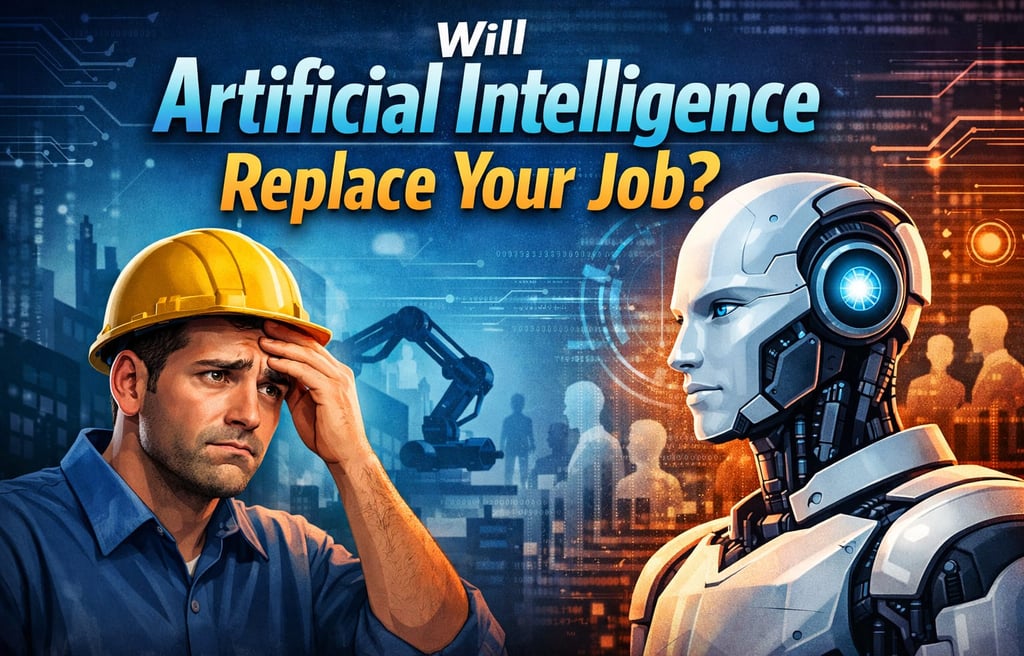
Artificial Intelligence has become one of the most talked-about technologies of the decade. Along with excitement, it has also triggered a growing fear: “Will AI replace my job?”
Headlines often suggest that machines will soon take over offices, factories, and even creative roles. Social media amplifies dramatic predictions, while movies portray AI as an unstoppable force replacing humans entirely. But how much of this fear is grounded in reality — and how much is pure myth?
In this article, we will separate facts from exaggeration, explain how AI is actually changing the job market, and help you understand what roles are at risk, which ones are evolving, and where new opportunities are emerging.
This is not a futuristic fantasy. It is a realistic, practical look at how Artificial Intelligence affects work today — and what it means for your career.
Why People Fear Artificial Intelligence in the Workplace
Fear of job loss caused by technology is not new. In the past, similar concerns appeared with:
Industrial machines
Computers
The internet
Automation software
Each wave of innovation changed how people worked — but did not eliminate work altogether.
AI feels different because it can:
Analyze data
Write text
Recognize images
Make decisions
These abilities make it seem like AI can “think,” which naturally raises concern.
Myth #1: Artificial Intelligence Will Replace All Jobs
This is the most common myth — and the most misleading.
AI does not replace jobs. It replaces specific tasks.
Most jobs are made up of multiple activities:
Decision-making
Human interaction
Creativity
Judgment
Emotional intelligence
AI excels at repetitive, data-driven tasks. It struggles with context, ethics, empathy, and complex human relationships.
As a result, entire professions rarely disappear. Instead, roles change.
Reality: AI Is Automating Tasks, Not People
In real-world applications, AI is mainly used to:
Speed up processes
Reduce repetitive work
Improve accuracy
Support human decisions
For example:
AI can analyze thousands of documents, but humans interpret results
AI can suggest content ideas, but humans define strategy
AI can process customer data, but humans handle complex cases
Automation shifts responsibilities — it does not erase human value.
Jobs Most Affected by Artificial Intelligence
Some roles are more exposed to automation than others.
High-Risk Tasks (Not Entire Jobs)
Data entry
Basic customer support
Simple content generation
Routine analysis
These tasks can often be automated partially or fully.
However, even in these areas, human oversight is still required.
Jobs That Are Evolving, Not Disappearing
Many professions are changing rather than vanishing.
Examples include:
Marketing professionals using AI for insights
Designers using AI as a creative assistant
Developers using AI to speed up coding
Writers using AI for drafts and research
In these roles, AI becomes a tool, not a replacement.
Myth #2: Only Low-Skill Jobs Are at Risk
Another misconception is that AI only threatens entry-level or manual work.
In reality, AI affects:
White-collar jobs
Creative roles
Technical professions
But again, it targets tasks, not entire careers.
For instance:
Lawyers use AI for document review
Doctors use AI for diagnostics
Financial analysts use AI for forecasting
Higher-skill roles are not immune — but they are augmented, not eliminated.
Reality: AI Increases Productivity Expectations
One real impact of AI is higher productivity standards.
Companies now expect:
Faster delivery
Better data analysis
Smarter decision-making
This can feel like pressure, but it also creates opportunities for professionals who adapt.
Those who learn to work with AI gain a competitive edge.
New Jobs Created by Artificial Intelligence
While some tasks disappear, new roles emerge.
Examples include:
AI trainers
Prompt engineers
Data analysts
AI ethics specialists
Automation consultants
Technology shifts demand — it does not reduce it to zero.
Myth #3: AI Will Make Human Skills Obsolete
This belief ignores what AI lacks.
AI does not possess:
Emotional intelligence
Moral judgment
Creativity driven by lived experience
Social understanding
Human skills like communication, leadership, adaptability, and critical thinking become more valuable, not less.
Reality: Human Skills Are Becoming More Important
As AI handles technical tasks, human-centered skills stand out.
Employers increasingly value:
Problem-solving
Creativity
Collaboration
Strategic thinking
Ethical reasoning
These are areas where AI cannot replace people.
How AI Is Changing Hiring and Recruitment
AI is also transforming how companies hire.
Recruitment tools now use AI to:
Screen resumes
Match candidates to roles
Analyze skills
This makes hiring faster — but also increases the importance of:
Clear skill presentation
Continuous learning
Personal branding
Should You Be Worried About Your Job?
The better question is not “Will AI replace my job?” but:
“How will my job change because of AI?”
If your role involves:
Learning
Decision-making
Creativity
Interaction
You are likely to evolve, not disappear.
How to Future-Proof Your Career
Practical steps anyone can take:
Learn How AI Works (At a Basic Level)
You don’t need to become a developer. Understanding fundamentals is enough.
Use AI Tools Instead of Avoiding Them
Hands-on experience builds confidence and relevance.
Strengthen Human Skills
Communication, leadership, and adaptability matter more than ever.
Stay Curious
Technology evolves — professionals who learn continuously stay valuable.
AI and the Illusion of Instant Replacement
Media narratives often exaggerate speed.
In reality:
Adoption takes time
Legal and ethical limits exist
Human trust is essential
Most companies adopt AI gradually, not overnight.
The Role of Governments and Regulation
Regulation slows reckless automation.
Many governments are introducing:
AI transparency rules
Worker protection policies
Ethical AI standards
This reduces the risk of sudden, uncontrolled job loss.
AI as a Career Accelerator, Not a Threat
For many professionals, AI becomes a career booster.
People who:
Master AI tools
Understand automation
Combine tech with human insight
Often advance faster than peers.
The Biggest Risk: Ignoring AI Completely
The real danger is not AI replacing you.
The real danger is being replaced by someone who knows how to use AI better than you do.
Avoiding AI does not stop change — it only reduces preparedness.
Separating Fear From Facts
Fear spreads faster than facts.
The truth is more balanced:
Some tasks disappear
Many roles evolve
New jobs emerge
Human value remains essential
Understanding this reduces anxiety and increases control.
Final Thoughts: AI Will Change Work, Not Eliminate It
Artificial Intelligence is reshaping the job market — but not destroying it.
Work is transforming, not ending.
Those who:
Adapt
Learn
Combine AI with human skills
Will remain relevant, valuable, and employable.
AI is not here to replace people.
It is here to change how people work.
And those who understand this difference are the ones who will thrive in the future of work.
Contact
Contact us with any questions or suggestions
Phone
alexament2222@gmail.com
+55 19 99373-9646
© 2026. All rights reserved.
Links